
Lucky Translate
DigitnesiaProductivity
4.7206.00 Reviews
- Version
- 1.3.2
- Installs
- 1.00M
- Age Rating
- Everyone
Screenshots

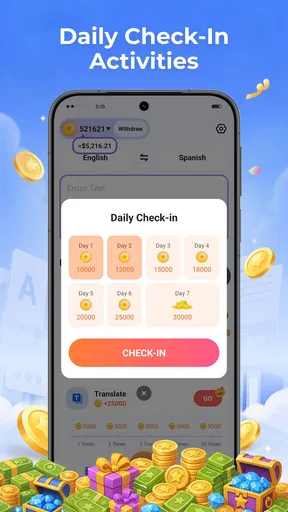
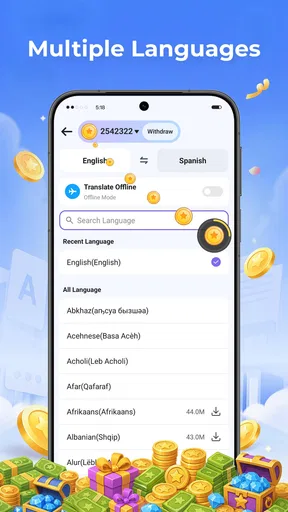

Our Review of Lucky Translate
 Analysis by Appyee
I approached Lucky Translate as a productivity app rather than as a conventional translation tool. Its central idea is simple: translate text and receive rewards. That combination makes it more interesting than a standard utility, but it also changes how I judge it. The important question is not only whether it can help me understand another language, but whether the reward-oriented experience fits naturally into the way I already translate.
Developed by Digitnesia, the app is free and aimed at everyone. It runs on Android devices using Android 8.0 or later, and its current version is 1.2.5. The application has built a visible user base, with over 500 thousand installs and a 4.4 average from around 3.9 thousand ratings. Those figures suggest that it has found an audience, although they do not remove the need to look closely at the actual workflow before making it part of a daily routine.
How I Decided Whether Lucky Translate Was Worth Keeping
My first test was practical: could I use it for the small translation jobs that appear during an ordinary day without feeling that the reward system was getting in the way? I thought about short messages, unfamiliar phrases, bits of text from a website, and quick checks while reading. For this kind of use, speed and low friction matter more than a long list of advanced options.
The second criterion was clarity. A translation app should make it obvious what I need to enter, what language is being handled, and what result I can act on. The reward element needs to remain understandable too. If I have to spend more time figuring out the incentive process than checking the translation, the productivity benefit becomes questionable.
The third criterion was trust in the result. I would not use any lightweight translation app as the final authority for a contract, medical instruction, immigration form, or emotionally sensitive message. That is not a criticism unique to this application; machine translation can miss tone, context, and cultural meaning. For Lucky Translate, I see the best role as a convenient first pass that helps me understand or prepare text before I verify important details elsewhere.
One useful way to assess it is to separate two jobs that people often mix together. The first is comprehension: finding out what a sentence probably means. The second is composition: producing polished text that another person will read. An app can be very useful for the first job while being less suitable for the second. I would personally use this app more confidently for reading than for sending a formal translation without review.
A realistic everyday workflow
Imagine receiving a short message from a seller in another language while comparing products online. I would open the app, translate the relevant wording, and use the result to decide whether I need to ask a follow-up question. That is a better fit than copying an entire page and treating the output as a perfect substitute for the original. The smaller the text and the clearer the context, the easier it is for me to judge whether the result makes sense.
A second scenario is travel preparation. I might use Lucky Translate to understand a menu item, a transport notice, or a basic instruction before leaving home. I would save the important original wording separately and avoid relying on a single translation for anything involving safety, payment, or official requirements. The app can reduce hesitation, but it should not replace common sense or a human explanation when the consequences are serious.
The reward angle may make repeated, low-stakes translation more appealing. If I already need to translate something, receiving an incentive can feel like a useful extra. I would not, however, invent translation tasks simply to chase rewards. That reverses the value equation: the app should support a real need first, while the reward remains secondary.
What the reward model changes
The phrase “translate and earn” sets an expectation that translation activity is connected to some reward process. Before investing time, I would read the in-app instructions carefully and check how progress is presented. A sensible habit is to understand what action qualifies, where the reward status appears, and whether any step requires additional attention. I would rather know the complete path before making the app part of a routine.
This is also where Lucky Translate differs from a normal translation utility. With a traditional tool, I open it, translate, and leave. Here, I have an additional reason to stay aware of the app’s flow. That can be motivating for some people, especially those who translate frequently. For others, it may feel like unnecessary mental overhead. The right choice depends on whether the incentive is genuinely useful to you or merely distracting.
My practical rule is to treat the reward as a bonus, never as proof that a translation is accurate. A reward does not improve grammar, preserve tone, or guarantee that an idiom has been understood correctly. Keeping those ideas separate helps prevent the most common mistake: trusting a convenient result simply because the app makes the activity feel productive.
Where Lucky Translate stands out
The clearest advantage is its unusual combination of a language utility and an incentive. Most translation apps focus entirely on getting an answer quickly. Lucky Translate gives users a reason to return beyond the immediate translation, which may suit someone who performs many short checks and enjoys seeing an extra benefit attached to that habit.
It also has a straightforward audience. Because it is free and rated for everyone, I can imagine it appealing to students, casual travelers, online shoppers, multilingual households, and people who occasionally communicate across languages. It does not need to become a major part of a person’s digital life to be useful; even occasional access can help with a phrase that would otherwise interrupt a task.
Another strength is the way it encourages a deliberate decision about translation frequency. If I only need help once every few weeks, a reward-based option may not matter much. If I repeatedly encounter foreign-language snippets while browsing or messaging, the incentive becomes more relevant. In that sense, the app is best judged by behavior rather than by a feature checklist.
The public response is encouraging without being a reason to lower my standards. A 4.4 average and roughly 3.9 thousand ratings indicate that many users are satisfied enough to rate it positively. I would still install it for my own workflow rather than assuming that a strong average automatically means it is ideal for every language, device, or use case.
Three habits that make the app more useful
First, I would translate the smallest meaningful piece of text instead of pasting a whole conversation immediately. Shorter segments are easier to compare with the original, and they make it simpler to notice when a name, place, or expression has been interpreted oddly. This also keeps the task focused when I am trying to make a quick decision.
Second, I would preserve context around ambiguous phrases. A single word can have several meanings, especially in product descriptions, jokes, and informal messages. If the result seems strangely literal, I would try the surrounding sentence rather than accepting the first wording automatically. This is a small change, but it turns the app from a button I press blindly into a tool I use with judgement.
Third, I would separate “understand now” tasks from “publish or send” tasks. For the first category, speed is the priority. For the second, I would review names, numbers, dates, politeness, and implied meaning before sharing the result. That distinction prevents a convenient translation from becoming an embarrassing message or a costly misunderstanding.
Where a conventional alternative may fit better
If my main need were polished writing, I would compare Lucky Translate with a more established translation service or a human translator rather than relying on the reward concept. The better alternative would be the one that gives me the level of linguistic control and contextual confidence my situation demands. Lucky Translate makes more sense when the task is quick understanding and the incentive adds value.
I would also choose a different category of tool for serious document work. A translation app may help me get the gist of a long document, but official paperwork often requires careful formatting, consistent terminology, and accountability. In that situation, I would want a service designed specifically for document translation or professional review. The free nature of Lucky Translate is attractive for casual use, but it should not be confused with a guarantee of professional output.
For live conversations, another type of translation solution may be more convenient if it is built around speech or dialogue. Lucky Translate is most naturally considered when I have text to process. If my priority is speaking with someone face to face, I would compare the interaction design of dedicated conversation tools before switching habits.
There is also a privacy decision to make with any translation service. I would avoid entering passwords, private identification details, confidential business material, or sensitive personal conversations unless I had a clear reason and understood the app’s handling of that content. This is a sensible boundary for translation tools generally, and it matters even more when an app introduces a reward-based workflow that encourages repeated use.
The real cost of switching
Because Lucky Translate is free, the financial barrier is low. The more meaningful cost is attention. I have to learn how its translation process works, understand the reward steps, and decide whether those steps fit naturally between the other things I am doing. If the process is quick and clear, that cost is easy to accept. If it repeatedly pulls me away from the original task, a familiar translation tool may remain faster in practice.
There is also a habit cost. I may already have a preferred translator built into my browser, keyboard, or phone. Switching means remembering to open another app and deciding when the reward is worth that extra movement. My recommendation would be to test it during a week of genuine translation needs rather than forcing it into every situation on the first day. That gives me a better sense of whether it saves effort or simply changes where the effort happens.
Device compatibility is relatively broad for older Android hardware because the minimum requirement is Android 8.0. Still, I would check how comfortably it behaves on my particular phone before depending on it while traveling or working. A tool that is technically compatible but awkward on a smaller screen is not necessarily the best practical choice.
The release date listed for the app is June 16, 2026, and the current version is 1.2.5. For me, that makes it sensible to pay attention to how the experience develops over time, especially because reward-based products can refine their instructions and presentation as users provide feedback. I would keep the app updated through the normal store process and revisit my expectations if the workflow changes.
Who should use it, and who should skip it?
I would recommend trying Lucky Translate if I regularly need quick help with short foreign-language texts and I like the idea of earning a reward while doing something I already planned to do. It is particularly easy to justify for casual translation: shopping messages, travel phrases, short posts, simple instructions, and everyday communication where a rough understanding is enough to move forward.
I would be more cautious if I rarely translate anything. In that case, the reward system may not compensate for installing and learning another utility. A standard translator already available on the phone could be more convenient. The same applies if I strongly dislike incentive-driven interfaces or prefer a completely minimal tool with no extra reason to revisit it.
I would skip it as my only solution for legal, medical, financial, academic, or professional translation. I would also avoid treating it as a replacement for a fluent speaker when tone and cultural nuance matter. The app can be part of the preparation process, but the final responsibility remains with me.
My recommendation after weighing the trade-offs
Lucky Translate is worth trying when the reward complements a genuine translation habit. Its free access, broad age suitability, and productivity focus make it approachable, while Digitnesia’s unusual translate-and-earn direction gives it a clear identity. I like the idea most for frequent, low-stakes text checks where I want an answer quickly and do not mind spending a moment understanding the incentive flow.
I would not choose it solely because it has a 4.4 average or more than 500 thousand installs. Those figures show interest and generally positive reception, but the decisive test is personal: does it help me finish translation tasks with less friction than my current option? If yes, the reward becomes a welcome extra. If no, the conventional alternative is probably the better productivity choice.
My final advice is to start with harmless, everyday text and judge both halves of the experience separately. Check whether the translation is useful for your languages and situations, then decide whether the reward process adds value rather than distraction. Used with that boundary, Lucky Translate is a distinctive free productivity app—not a universal replacement for professional translation, but a practical option for people who want quick language help with an incentive attached.
Verdict
Strengths of Lucky Translate
- Supports quick translations for everyday conversations and short messages.
- Simple interface makes core translation tools easy to find.
- Useful for travelers who need help with common phrases on the go.
- Can reduce the need to switch between multiple language apps.
- Helpful for checking the meaning of unfamiliar words and sentences.
Limitations of Lucky Translate
- Translation quality may vary with slang, regional phrases, and complex grammar.
- Some features may require an internet connection to work reliably.
- Automatic translations can miss tone, context, or cultural nuances.
- Privacy details should be reviewed before entering sensitive text.
- Frequent users may encounter ads or limitations in the free version.
Other Releases by Digitnesia
View All
Lucky Drama - Shorts & Rewards
Entertainment4.8
Similar Picks in This Category
View All
Google Calendar
Google LLC4.6

Google Drive
Google LLC4.3

Google Assistant
Google LLC3.9

Microsoft OneDrive
Microsoft Corporation4.6

Samsung Calendar
Samsung Electronics Co., Ltd.4.1

Microsoft OneNote: Save Notes
Microsoft Corporation4.6
Frequently Asked Questions
What is Lucky Translate, and what can I use it for?
Lucky Translate is a translation-focused mobile application designed to help users understand and communicate in different languages. Depending on the version available on your device, it may support text translation, copied-content translation, voice input, or camera-based translation. It can be useful for travel, messaging, study, and everyday conversations, although results may vary with slang, regional expressions, poor audio, or complex sentences.
Does Lucky Translate require an internet connection to work?
Most translation applications perform best when they are connected to the internet because translations are processed through online language services. Lucky Translate may offer limited functionality without a connection, but offline availability can depend on the language pair and the app version. Before traveling or relying on it in an area with weak coverage, check its settings and test the required languages in advance.
Which languages and translation features are supported?
The available languages and tools can vary between Android and iOS releases, as well as between different updates. Lucky Translate may include written translation and could provide additional options such as voice, conversation, or image translation. Users should review the language list inside the app before downloading, especially if they need a less commonly supported language or a specific feature for work, travel, or accessibility.
Is Lucky Translate accurate enough for important conversations or documents?
Lucky Translate can be helpful for general communication, travel phrases, menus, short messages, and everyday text, but no automatic translator should be treated as perfect. Accuracy may decrease with technical terminology, humor, idioms, dialects, handwriting, or unclear pronunciation. For legal, medical, financial, academic, or professional documents, its output should be checked by a qualified human translator before it is used.
Is Lucky Translate free, and should I be concerned about privacy?
Lucky Translate may be available to download at no initial cost, but some versions can include advertisements, optional purchases, subscriptions, or limits on certain tools. Review the store listing and in-app pricing before activating a premium feature. Also check the privacy policy and requested permissions, particularly for microphone, camera, photos, or copied text, and avoid entering sensitive personal, financial, or confidential information.
